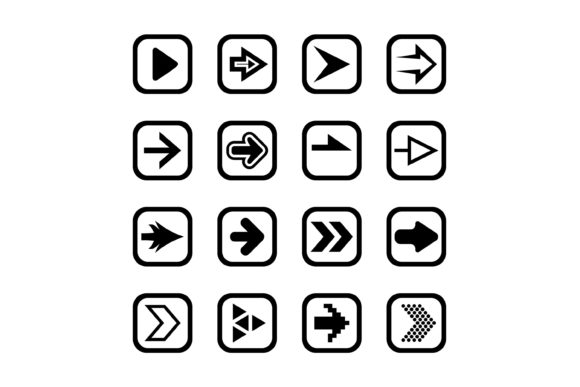
Arrow Icons: A Versatile Tool for Designers and Creators
Arrow icons are more than just visual elements—they are powerful tools that enhance communication, streamline workflows, and improve user experience across a wide range of applications. Whether you're designing digital interfaces, creating print materials, or managing complex processes, arrow icons play a crucial role in conveying direction, action, and clarity. In this article, we explore the significance of arrow icons, their practical uses, and how they can be integrated into various projects using file formats like EPS.
The Role of Arrow Icons in Visual Communication
Arrow icons are fundamental in visual design because they represent movement, guidance, and direction. They are used in everything from navigation menus to instructional diagrams, making them essential for both digital and physical media. Their simplicity allows for universal understanding, which is why they are widely adopted in fields such as web development, graphic design, and even education.
One of the most common use cases for arrow icons is in user interface (UI) design. For instance, directional arrows in apps help users navigate through features with ease. Similarly, in educational materials, arrows can guide readers through step-by-step instructions, ensuring clarity and reducing confusion. The versatility of arrow icons makes them an indispensable asset for designers aiming to create intuitive and effective layouts.
EPS Files: A Professional Choice for High-Quality Graphics
When working with arrow icons, the choice of file format can significantly impact the quality and scalability of your designs. Among the many options available, EPS (Encapsulated PostScript) files stand out for their precision and compatibility. EPS files are vector-based, meaning they maintain crisp edges and sharp details regardless of size or resolution. This makes them ideal for use in professional environments where high-quality output is essential.
EPS files are particularly well-suited for use with design software such as Adobe Illustrator CC, Adobe Suite, Inkscape, Corel Draw, and more. These programs allow designers to manipulate arrow icons with precision, adjusting colors, sizes, and styles without compromising quality. Additionally, the open nature of the EPS format ensures that it remains compatible with a wide range of tools, making it a flexible choice for creators of all levels.
Why Choose EPS for Arrow Icon Projects?
- Scalability: EPS files can be scaled infinitely without loss of quality, making them perfect for large-format prints or digital displays.
- Compatibility: EPS files work seamlessly with popular design software, ensuring smooth integration into existing workflows.
- Professional Quality: The vector-based nature of EPS ensures that arrow icons remain sharp and clear, even when printed at high resolutions.
- Customization: Designers can easily modify arrow icons within EPS files, allowing for personalized and unique designs tailored to specific projects.
Applications of Arrow Icons in Real-World Projects
Arrow icons find application in numerous industries and creative endeavors. From branding to product design, their adaptability ensures that they remain relevant across diverse contexts. Let's explore some of the key areas where arrow icons are commonly used:
Graphic Design and Branding
In the world of branding, arrow icons are often used to convey direction and movement. For example, a company might use a stylized arrow icon in its logo to symbolize progress, innovation, or forward-thinking. These icons can also be incorporated into marketing materials, such as brochures, social media graphics, and website banners, to reinforce brand messaging.
Designers frequently use arrow icons in infographics and data visualizations to guide the viewer's eye through complex information. By strategically placing arrows, they can highlight key points, illustrate relationships, and make content more engaging and easier to digest.
Product Design and Manufacturing
Arrow icons are not limited to digital spaces—they are also integral to physical product design. For instance, in the creation of shirts, wood signs, mugs, tumblers, cards, and party decor, arrow icons can be used to add visual interest and functionality. These icons can serve as decorative elements or as part of instructional markings, such as directions on packaging or usage guidelines on products.
For handmade businesses, EPS files offer a significant advantage. Since they are scalable and editable, designers can create custom arrow icons that align with their brand identity and product line. This flexibility allows for consistent and high-quality outputs across various product types, enhancing both aesthetics and usability.
Education and Instructional Materials
Arrow icons are invaluable in educational settings, where clarity and simplicity are paramount. Teachers and educators often use arrows to guide students through lessons, illustrate steps in a process, or direct attention to specific parts of a diagram. These icons can be found in textbooks, online courses, and interactive learning platforms, helping to break down complex concepts into manageable pieces.
Moreover, arrow icons can be used in training manuals and workplace guides to provide clear instructions and visual cues. Their ability to communicate direction effectively makes them a powerful tool for improving comprehension and reducing errors in both academic and professional environments.
Best Practices for Using Arrow Icons in Design Projects
To ensure that arrow icons are used effectively in your design projects, consider the following best practices:
- Choose the Right Style: Select an arrow style that aligns with the overall aesthetic of your project. Options include simple lines, filled shapes, and intricate designs, each offering different visual impacts.
- Ensure Consistency: Maintain a consistent arrow style throughout your design to avoid confusion and ensure a cohesive look.
- Use Appropriate Color: Choose colors that complement your design palette and enhance readability. Avoid overly bright or distracting hues unless the intent is to draw attention.
- Test Scalability: Before finalizing your design, test how the arrow icons appear at different sizes and resolutions to ensure they remain clear and legible.
- Consider Context: Always think about the context in which the arrow icons will be used. For example, a subtle arrow might be more appropriate for a minimalist design, while a bold arrow could work well in a dynamic or energetic layout.
Conclusion
Arrow icons are more than just decorative elements—they are functional tools that enhance communication, guide users, and improve the overall effectiveness of design projects. Whether you're working on digital interfaces, print materials, or handmade goods, the right arrow icon can make a significant difference. When paired with high-quality file formats like EPS, these icons become even more versatile, allowing for seamless integration into a wide range of creative and professional applications.